 +91-9958 726825
Artificial Intelligence in customer relationship managArtificial Intelligence in Customer Relationship Management: A Conceptual Framework for AI-driven retention, personalisation, and sustainable business growth
|
Artificial Intelligence (AI) has fundamentally transformed how organisations manage and sustain customer relationships in competitive business environments. This paper presents a conceptual review and framework examining the role of AI in Customer Relationship Management (CRM), with particular emphasis on three strategic pillars: predictive customer retention, personalised service delivery, and sustainable business growth. Drawing on a synthesis of recent literature spanning AI-driven analytics, machine learning, natural language processing, and Explainable AI (XAI), this study proposes an integrated AI-CRM framework that maps specific AI capabilities to CRM functions and measurable business outcomes. The paper further identifies key ethical considerations—including data privacy, algorithmic bias, and regulatory compliance—as essential dimensions of responsible AI deployment in CRM. By situating the discussion within an Information Systems Management perspective, the paper contributes a structured conceptual model intended to guide researchers and practitioners in designing AI-enabled CRM systems that are effective, transparent, and sustainable. Limitations of the current study and directions for future empirical research are explicitly acknowledged.
|
|
The integration of Artificial Intelligence (AI) into Customer Relationship Management (CRM) represents one of the most consequential developments in contemporary Information Systems Management. AI-enabled CRM systems have moved organisations far beyond traditional data storage and transactional record-keeping, enabling real-time behavioural analysis, predictive personalisation, and proactive customer engagement at unprecedented scale[1] [29] . As digital transformation accelerates across industries, the capacity to intelligently anticipate and respond to customer needs has become a defining source of competitive advantage.
Despite the growing volume of literature on AI applications in business, a notable gap remains in research that consolidates diverse AI capabilities—spanning machine learning, natural language processing, and explainable AI—within a coherent CRM framework grounded in Information Systems theory. Much of the existing work addresses specific technical applications, such as churn prediction in telecommunications or credit risk modelling in banking, without situating these contributions within a unified AI-CRM perspective[1] [1] . This fragmentation limits the theoretical and practical utility of such studies for CRM system designers and business strategists. |
|
To develop a conceptual framework that maps AI capabilities to CRM functions and business outcomes, with the aim of informing the design of effective, ethical, and sustainable AI-enabled CRM systems.
In pursuit of this objective, the paper synthesises a broad body of recent literature, organises findings into thematic categories, and proposes an integrated AI-CRM framework. The framework identifies three strategic pillars—predictive retention, personalised service, and sustainable growth—as the core outcomes of AI-driven CRM, and links each to specific AI capabilities and enabling technologies. The paper is explicitly conceptual and review-based in nature; it does not present original empirical data but instead provides theoretical synthesis and a structured conceptual contribution. |
|
Conceptual Synthesis Approach / Methodology
This paper adopts a conceptual review methodology, which is appropriate for the study’s objective of synthesising existing knowledge and proposing an integrated theoretical framework. Unlike empirical studies that collect and analyse primary data, conceptual research derives its contribution from the systematic integration, critical analysis, and reinterpretation of existing literature to produce new theoretical insights or structured frameworks[23] .
This approach allows the paper to move beyond descriptive enumeration of prior work towards synthesis and interpretation, consistent with the requirements of a conceptual contribution in the Information Systems Management domain. |
|
This section organises existing research into four thematic domains:
AI-Driven Predictive Analytics for Customer Retention Personalisation and Intelligent Automation in CRM Explainable AI, Ethics, and Regulatory Considerations The AI-CRM Systems Perspective |
|
Theoretical and Managerial Implications
The proposed AI-CRM framework makes several theoretical contributions to the Information Systems Management literature. First, it provides a structured, multi-dimensional mapping of AI capabilities to CRM outcomes—extending beyond the fragmented, application-specific treatments prevalent in the literature. Second, it explicitly incorporates ethical governance and XAI as integral components of sustainable AI-CRM design, rather than treating them as peripheral concerns. Third, by anchoring the discussion within CRM lifecycle theory and relationship marketing, it provides a theoretically grounded vehicle for future empirical research. From a managerial perspective, the framework offers CRM leaders a structured decision-support tool for AI technology selection and deployment planning. Organisations can use the capability-to-outcome mapping in Table 1 to prioritise AI investments aligned with their specific retention, service, or growth objectives. The classification in Table 2 further assists technology selection by linking AI tools to validated CRM functions and relevant literature benchmarks. For CRM system designers, the framework highlights the importance of building interpretability and fairness into AI models at the design stage rather than retrofitting these properties post-deployment. The integration of XAI capabilities—specifically SHAP and LIME—within predictive retention modules is particularly recommended, as these tools enable CRM teams to understand and communicate the basis for automated decisions to both customers and regulators. Ethical Considerations and Responsible AI in CRM |
|
This study has several limitations that should be explicitly acknowledged. First, as a conceptual and review-based paper, it does not present original empirical data. The proposed framework has not yet been validated through quantitative or qualitative fieldwork, and its propositions remain theoretical pending empirical testing.
Second, the literature synthesis, while broad, is not exhaustive. Selection of studies was guided by relevance to the AI-CRM theme and recency; studies published before 2019 were included selectively. Relevant works in non-English-language literature or in emerging market contexts may not have been fully captured. Third, the framework is presented at a level of abstraction intended to ensure broad applicability across industries and CRM contexts. Sector-specific adaptations—particularly for industries with distinct regulatory environments such as healthcare and financial services—would require additional tailoring beyond the scope of this paper. |
|
The Proposed AI-CRM Conceptual Framework
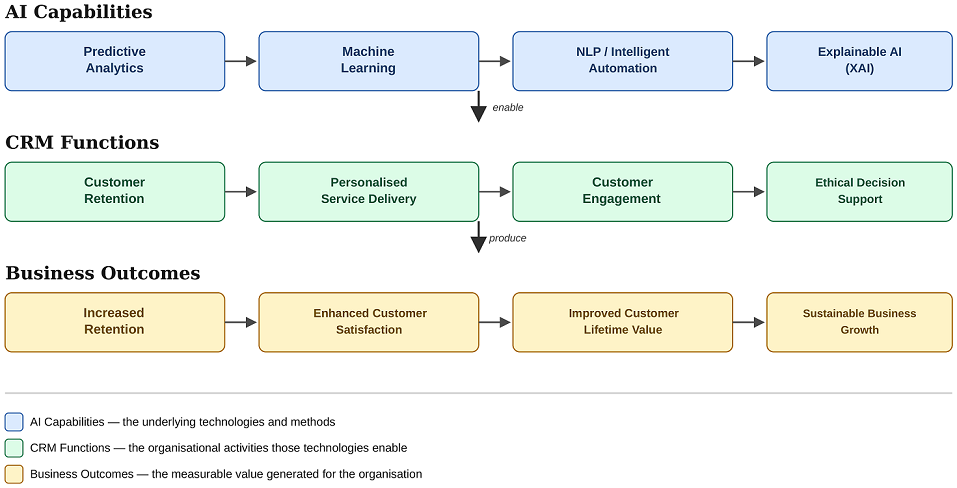
Based on the synthesis of literature, this paper proposes an AI-CRM Conceptual Framework organised around three strategic pillars: (i) Predictive Customer Retention, (ii) Personalised Service Delivery, and (iii) Sustainable Business Growth. Each pillar is enabled by specific AI capabilities and technologies, and produces measurable CRM and business outcomes. Table 1 provides a structured mapping of these dimensions, and Figure 1 presents the corresponding conceptual diagram.
Source: Authors’ synthesis from reviewed literature Table 1 : AI-CRM Conceptual Framework — Mapping AI Capabilities to CRM Outcomes
Figure 1 : Conceptual Representation of the AI–CRM Framework — AI Capabilities Enabling CRM Functions to Produce Business Outcomes (corresponds to Table 1)
Pillar I: Predictive Customer Retention Pillar II: Personalised Service Delivery Pillar III: Sustainable Business Growth Classification of AI Tools by CRM Application Domain
Source: Authors’ synthesis from reviewed literature
Table 2 : Classification of AI Tools, CRM Application Domains, and Business Outcomes
|
|
This paper has presented a conceptual review and integrated AI-CRM framework addressing the transformative role of Artificial Intelligence in Customer Relationship Management. By synthesising a broad body of recent literature, the paper identified three strategic pillars—predictive customer retention, personalised service delivery, and sustainable business growth—as the core outcome dimensions of effective AI-CRM integration.
The proposed framework provides a structured mapping of AI capabilities to CRM functions and business outcomes, accompanied by a classification of AI tools across CRM application domains. These contributions are intended to serve as both a theoretical reference for Information Systems Management research and a practical decision-support tool for CRM leaders and system designers. The paper explicitly acknowledges its conceptual nature and the consequent need for empirical validation, and it underscores the critical importance of ethical governance, transparency, and regulatory compliance as non-negotiable design requirements for responsible AI-CRM deployment. As AI technologies continue to evolve, organisations that combine technical sophistication with a commitment to ethical, human-centred design will derive the greatest long-term value from AI-CRM investments. The framework proposed here is offered as a foundation upon which more specific empirical, methodological, and sector-specific contributions can be built. The convergence of AI capabilities and CRM strategy holds transformative potential for how organisations understand, serve, and sustain their customer relationships in an increasingly digital and competitive world. |

Pain Text:
Monika Bhatia, Dinesh Bhatia (2026), Artificial Intelligence in customer relationship managArtificial Intelligence in Customer Relationship Management: A Conceptual Framework for AI-driven retention, personalisation, and sustainable business growth. Samvakti Journal of Research in Business Management, 7(2) .
Monika Bhatia, Dinesh Bhatia (2026), Artificial Intelligence in customer relationship managArtificial Intelligence in Customer Relationship Management: A Conceptual Framework for AI-driven retention, personalisation, and sustainable business growth. Samvakti Journal of Research in Business Management, 7(2) .