
Article ID : sjrit.2026.2 | Open Access

Navigating Autonomous Finance: Acceptance of Agentic AI Among Gen Z and Millennials in Bangalore Urban


Deepthi H , Nikitha K , Renushree S
Submission Date : February 27, 2026 Publication Date : June 26, 2026


Financial services are being changed through appearance of agentic Artificial Intelligence (AI), which facilitates the use of autonomous systems capable of tracking, analysing, and implementing financial choices on behalf of the user. This paper focuses on how Gen Z and Millennial users in Bangalore Urban accept Agentic AI in autonomous financial decision-making. The quantitative research design was used, and a structured questionnaire measured on a five-point Likert scale was used to collect data on 400 respondents. The AI autonomy, competence, transparency, user control, trust, and intention to adopt AI relationship was investigated through structural equation modelling (SEM) as a moderator of the result. The results highlights that AI competence and autonomy have strongly positive effects on trust, which is a powerful factor in adoption intention. In addition, Gen Z also exhibits better acceptance than Millennials. This study contributes to the fintech adoption literature by demonstrating that trust and generational differences play a critical role in autonomous financial environments. The results have a practical implication to the developers of fintech to create transparent and trustworthy financial systems that are driven by AI.
Artificial Intelligence (AI) is rapidly transforming the financial services industry, evolving from rule-based automation and predictive analytics toward increasingly sophisticated decision-making systems[1] [3] [12] . Traditional AI applications in finance such as fraud detection, credit scoring, and robo-advisory platforms primarily function as decision-support systems, enhancing efficiency and accuracy while preserving human control over final decisions[4] [8] . In these contexts, AI augments human judgment rather than replacing it, maintaining a human-in-the-loop model of financial decision-making. A significant recent development in this domain is the emergence of Agentic AI, which represents a fundamental shift from assistive intelligence to systems with independent decision-making capabilities. Agentic AI can be defined as goal-directed, adaptive systems that are capable of autonomously initiating, evaluating, and executing decisions with minimal or no human intervention [2] [11] . Unlike traditional algorithmic systems that operate within predefined rules or semi-autonomous systems that require user validation, Agentic AI systems exhibit independent agency, characterized by contextual awareness, continuous learning, and the ability to act proactively rather than reactively.

This distinction is conceptually important. Conventional algorithmic systems in finance rely on deterministic logic and predefined instructions, while autonomous tools such as robo-advisors operate within constrained parameters set by users. In contrast, Agentic AI integrates decision authority, adaptability, and action initiation, thereby shifting the locus of control from human users to intelligent systems. As a result, the human–AI relationship transitions from one of support and augmentation to one of delegation and substitution, where users entrust not only execution but also judgment to AI systems [3] [8] . The movement toward Agentic AI has significant implications for user behavior, particularly in high-stakes domains such as financial decision-making. Financial decisions inherently involve risk, uncertainty, and long-term consequences, making trust a critical determinant of technology adoption[2] [5] [13] . In traditional AI environments, trust operates alongside human oversight, allowing users to verify, override, or calibrate system outputs. However, in Agentic AI contexts, users are required to relinquish direct control over decision-making processes, fundamentally altering the nature of trust from a supporting factor to a central mediating mechanism influencing adoption [9] .

Type of System Role of Human Decision Authority Adaptability Example
Traditional AI High Human final say Low–Moderate Fraud detection
Algorithmic systems Medium Rule-based Low Trading algorithms
Autonomous AI Low System executes Moderate Robo-advisors
Agentic AI Minimal System initiates & decides High (learning + goal-driven) Fully autonomous finance
Table 1 : Comparative Overview of AI System Types in Financial Decision-Making

Unlike traditional AI systems such as fraud detection or robo-advisors, which function as decision-support tools requiring human validation, Agentic AI systems exhibit higher levels of autonomy by independently initiating, executing, and optimizing financial decisions. Furthermore, while conventional algorithmic systems follow predefined rules, Agentic AI systems are adaptive, context-aware, and capable of learning from dynamic environments without continuous human oversight. Despite the growing body of literature on AI in finance, most existing studies focus on assistive or semi-autonomous systems where human supervision remains integral[4] [8] [9] . Consequently, current theoretical frameworks do not adequately capture user behavior in environments characterized by full delegation of decision authority to AI systems. Furthermore, although explainable AI research emphasizes transparency as a key driver of trust[5] [10] , it remains unclear whether transparency retains its importance when users are no longer actively involved in the decision-making process. This highlights a critical gap in understanding how trust is formed and sustained in fully autonomous, agent-driven financial environments conceptual gaps, generational differences may further influence the acceptance of Agentic AI systems. Prior research suggests that younger cohorts, particularly Generation Z, demonstrate higher levels of digital literacy and greater openness to emerging technologies, whereas Millennials may exhibit relatively higher sensitivity to risk and loss of control[5] [6] . However, empirical evidence examining generational differences specifically in the context of Agentic AI and autonomous financial decision-making remains limited, particularly within rapidly evolving Urban ecosystems. Against this backdrop, the present study investigates the acceptance of Agentic AI in autonomous financial decision-making among Gen Z and Millennials in Bangalore Urban. Specifically, it examines how system-level attributes namely autonomy, competence, transparency, and perceived loss of control influence trust, and how trust subsequently shapes behavioral intention to adopt such systems. By clearly conceptualizing Agentic AI as distinct from traditional and semi-autonomous systems, this study contributes to the fintech and AI adoption literature by positioning trust as the central mechanism in environments characterized by full decision delegation and by providing empirical insights into generational differences in emerging autonomous financial ecosystems.
 

According to the conceptual model, the hypotheses of the study were:

H1 Autonomy has a positive effect on Agentic AI trust.
H2 The trust in Agentic AI is positively impacted by algorithmic transparency.
H3 Competence has a positive effect on Agentic AI trust.
H4 The loss of human control has a negative effect on Agentic AI trust.
H5 Confidence in Agentic AI has a positive effect on behavioral intention to use autonomous financial systems.

Furthermore, trust was proposed as an intermediary between factor between system traits and behavioral intention, and generation (Gen Z vs Millennials) was proposed as a moderating factor that effects adoption behavior.
 

Research Design
This study employs a quantitative, cross-sectional research design to examine the acceptance of Agentic AI in autonomous financial decision-making. A structured survey method was used to test the proposed conceptual model and hypotheses. Structural Equation Modeling (SEM) was applied due to its suitability for analyzing relationships among latent constructs and testing mediation effects. The cross-sectional approach is appropriate given the exploratory nature of Agentic AI adoption.

Population and Sampling
The target population comprises Gen Z (1997–2012) and Millennials (1981–1996) in Bangalore Urban with prior experience using digital financial services (e.g., mobile banking, fintech apps, robo-advisors). Bangalore Urban was selected due to its status as a leading fintech and technology hub with high digital adoption, making it a relevant context for studying early acceptance of Agentic AI. A purposive sampling technique was used, with screening criteria ensuring respondents had active fintech usage experience. Data were collected through an online survey distributed via professional networks, fintech communities, and targeted social media groups. A total of 400 valid responses were obtained, meeting recommended thresholds for SEM and ensuring adequate statistical power. While the sampling is non-probabilistic and geographically limited, the context represents an advanced digital ecosystem, providing indicative insights into early-stage adoption behavior. Generalizability beyond similar Urban settings should be made with caution.

Instrument Development
The questionnaire was developed using validated multi-item scales from prior studies on AI adoption, technology trust, and fintech acceptance. Each construct was operationalized using a minimum of three reflective indicators drawn from established instruments to ensure content validity and theoretical fidelity. Items were adapted to the Agentic AI and autonomous financial decision-making context with minor wording modifications. All items were assessed on a 5-point Likert scale (1 = Strongly Disagree, 5 = Strongly Agree). A pilot study (n = 40) was conducted to ensure item clarity, semantic appropriateness, and content validity, followed by minor item-level revisions. The measurement items used in this study were adapted from previously validated scales in the literature and contextualized for autonomous AI-based financial decision-making systems. AI Autonomy (AUT) was measured using four items adapted from Rai et al.[9] , Choung et al. [2] , Belanche et al.[1] , and Dwivedi et al.[3]  . Algorithmic Transparency (TRN) was assessed through three items adapted from Shin[10] and Venkatesh et al. [11] . AI Competence (CMP) was measured using four items derived from Zhang et al.[13] , Belanche et al.[1] , and Choung et al. [2] . Perceived Loss of Control (CTL) was assessed using three items adapted from Hu et al.[5]  and Jünger and Jünger[6]. Trust in Agentic AI (TRS) was measured using four items adapted from Choung et al.[2] , Zhang et al. [13] , and Belanche et al.[1]. Finally, Behavioral Intention (INT) was measured using three items adapted from Venkatesh et al.[11] , Hu et al.[5] , and Belanche et al.[1] . All items were measured using a five-point Likert scale ranging from 1 (“Strongly Disagree”) to 5 (“Strongly Agree”).

Data Analysis
A four-stage SEM procedure was applied:

  • Measurement Model: CFA to assess reliability, convergent and discriminant validity
  • Structural Model: Path analysis using β, t-values, and p-values
  • Mediation Analysis: Bootstrapping (5000 resamples) to test indirect effects of trust
  • Group Comparison: Mean comparison to examine generational differences

The group comparison provides indicative differences; however, it does not test structural invariance. Future research may apply Multi-Group SEM (MG-SEM) for rigorous moderation analysis.

Common Method Bias Assessment
Common method bias was minimized through procedural and statistical remedies. Psychological separation of constructs, respondent anonymity, and reverse-coded items were incorporated during survey design. Harman’s single-factor test showed that the first factor explained only 26.3% of variance (<50%), while the Common Latent Factor analysis indicated negligible method effects (ΔCFI < 0.01; ΔRMSEA < 0.005), confirming that common method bias is unlikely to threaten the validity of the study findings.

Ethical Considerations
Participation was voluntary, with informed consent obtained from all respondents. Anonymity and confidentiality were maintained, and no personally identifiable information was collected. The study adhered to standard ethical guidelines for human subject research.
 

AI in Financial Services: From Assistive to Agentic Systems
Artificial Intelligence (AI) has emerged as a transformative force in financial services, enabling applications such as fraud detection, credit scoring, algorithmic trading, and portfolio management[1] [3] [12] . These systems have significantly improved operational efficiency, accuracy, and scalability within financial institutions[3] . However, the majority of existing AI applications function as assistive or decision-support systems, where human users retain ultimate authority over financial decisions[4] [8] . In such contexts, AI augments human judgment rather than replacing it, operating within a human-in-the-loop framework. While prior research has extensively examined user adoption of AI-enabled financial services, most studies are grounded in scenarios where AI complements, rather than substitutes, human decision-making[4] [5] . As a result, existing models of fintech adoption primarily based on perceived usefulness, ease of use, and trust may not fully capture user behavior in environments where decision authority is delegated entirely to AI systems[8] . A significant conceptual advancement in this domain is the emergence of Agentic AI, which represents a shift from assistive intelligence to systems capable of independent action. Unlike traditional algorithmic systems that rely on predefined rules or semi-autonomous tools that require user validation, Agentic AI systems are goal-directed, adaptive, and capable of autonomously initiating and executing decisions[2] [11] . This distinction is critical, as it introduces a new paradigm in which AI systems possess independent agency, fundamentally altering the role of humans in financial decision-making processes.

Trust in AI Under Conditions of Full Autonomy
Trust has been widely recognized as a central determinant of AI adoption, particularly in high-risk and high-uncertainty domains such as financial services[2] [5] [13] . Prior studies suggest that users are more likely to adopt AI systems when they perceive them as competent, reliable, and aligned with their interests[6] [7] . In traditional AI contexts, trust operates alongside human oversight, allowing users to monitor, verify, and override system recommendations. However, the emergence of Agentic AI fundamentally transforms the nature of trust. When decision-making authority is fully delegated to AI systems, users can no longer rely on direct control or intervention, thereby increasing their vulnerability to system outcomes. In such contexts, trust shifts from a supporting condition to a primary mediating mechanism influencing adoption behavior[9] . This implies that users must develop confidence not only in the system’s outputs but also in its ability to act autonomously in their best interest. Despite its importance, the role of trust in fully autonomous, agent-driven environments remains underexplored. Existing literature predominantly focuses on semi-autonomous systems, where human oversight mitigates perceived risks [4] [8] . Consequently, there is a need to reconceptualize trust in the context of Agentic AI, where users are required to relinquish control entirely.

Transparency, Explainability, and Their Evolving Role
The concept of explainable AI (XAI) has been extensively studied as a mechanism to enhance transparency and improve user trust in AI systems [10] . Transparency reduces uncertainty, increases perceived fairness, and enables users to better understand system decisions, thereby facilitating adoption[6] [10] . This is particularly important in financial contexts, where decisions have significant economic implications. However, most research on transparency is grounded in environments where users remain actively involved in the decision-making process. In such settings, explainability enables users to validate and interpret AI recommendations. In contrast, in Agentic AI environments where systems operate with full autonomy the relevance of transparency may change. Users may be less concerned with understanding how decisions are made and more focused on whether the system consistently delivers reliable outcomes. This suggests a potential shift from explainability-based trust to performance-based trust, where system competence and effectiveness become more important than interpretability. While this perspective is gaining attention, empirical evidence examining the relative importance of transparency in fully autonomous systems remains limited[3] [10] . Addressing this gap is essential to understanding how trust is formed in Agentic AI contexts.

System-Level Attributes and Trust Formation
Prior literature identifies several system-level attributes that influence trust in AI, including autonomy, competence, transparency, and control [2] [13] . In traditional systems, these attributes operate within a framework where users retain decision authority. However, in Agentic AI environments, their roles may differ significantly. Autonomy reflects the system’s ability to operate independently without human intervention. Higher autonomy can enhance efficiency but may also increase perceived risk due to reduced human control Competence refers to the system’s ability to perform tasks accurately and effectively, serving as a critical driver of trust across AI applications[2] [13] .
Transparency enables users to understand system processes, though its relevance may diminish in fully autonomous settings. Perceived loss of control represents a psychological barrier, as users may resist systems that limit their ability to intervene in decision-making. While prior studies have examined these factors individually, their combined influence in fully autonomous, agent-driven financial environments remains insufficiently understood. In particular, the relative importance of performance-based attributes (autonomy and competence) versus interpretability-based attributes (transparency and control) requires further investigation.

Generational Differences in AI and Fintech Adoption
Generational differences play a significant role in shaping technology adoption behavior. Existing studies suggest that younger cohorts, particularly Generation Z and Millennials, are more likely to adopt digital financial services due to higher levels of digital literacy and familiarity with technology[5] [6] . However, differences exist even within these groups. Generation Z, as digital natives, may exhibit greater comfort with automation and a higher willingness to delegate decisions to AI systems. In contrast, Millennials, despite being technologically proficient, may demonstrate greater sensitivity to risk, privacy concerns, and loss of control. These differences become particularly relevant in the context of Agentic AI, where users are required to trust systems with independent decision-making authority. Despite these insights, empirical research comparing generational responses to fully autonomous, Agentic AI systems remains limited, especially in emerging Urban ecosystems characterized by rapid technological adoption [9] . Understanding these differences is essential for designing user-centric AI systems and developing targeted adoption strategies.

Theoretical Framework
The conceptual framework of this study is grounded in two of the most widely validated theories of technology adoption: the Technology Acceptance Model (TAM) and the Unified Theory of Acceptance and Use of Technology (UTAUT). These theories provide the theoretical scaffolding upon which the Agentic AI adoption model is constructed, while simultaneously being extended to address the unique challenges posed by fully autonomous financial systems. The Technology Acceptance Model [6]  proposes that Perceived Usefulness (PU) and Perceived Ease of Use (PEOU) are the primary determinants of behavioral intention toward technology adoption. In the context of Agentic AI, AI Competence serves as a direct analogue to perceived usefulness reflecting users' beliefs that the system can perform financial tasks more effectively than manual alternatives. Similarly, AI Autonomy maps conceptually onto reduced effort expectancy, as an autonomous system reduces the cognitive burden on users by independently managing financial decisions. The present study extends TAM by introducing Trust as a critical mediating construct between system-level attributes and behavioral intention. This extension is theoretically justified given that in Agentic AI contexts, users cannot directly verify system outputs, making trust an indispensable psychological mechanism bridging system capability perceptions and adoption intention. This is consistent with extended TAM models that incorporate trust as a mediator in high-risk digital environments [5] .

UTAUT Construct Corresponding Construct in Present Study Justification
Performance Expectancy AI Competence + AI Autonomy Both reflect beliefs about system effectiveness and value delivery
Effort Expectancy AI Autonomy (low effort) Autonomous operation reduces user cognitive load
Social Influence Not directly measured Limited in early-adoption, technology-savvy urban samples
Facilitating Conditions Algorithmic Transparency Transparency provides the informational infrastructure enabling users to feel supported
Trust (Extended) Trust in Agentic AI Added as a core mediating mechanism given the full delegation context
Table 2 : Mapping of UTAUT Constructs to the Present Study's Framework
Beyond these classical mappings, this study extends UTAUT by acknowledging that in fully autonomous systems, the traditional construct of Perceived Loss of Control represents a unique inhibitor that is largely absent from existing UTAUT formulations. In standard technology adoption contexts, users retain agency over system use and outputs. In Agentic AI environments, however, users delegate decision authority entirely, introducing a psychological resistance that undermines trust formation. This construct is theoretically positioned as a negative antecedent of trust, analogous to inhibitors identified in hedonic and risk-sensitive technology adoption models   Furthermore, the moderating role of Generation (Gen Z vs. Millennials) aligns with UTAUT2's emphasis on Experience and Voluntariness of Use as moderating variables. Digital nativity and technology familiarity—more pronounced in Gen Z—are expected to moderate the strength of performance expectancy and trust relationships with behavioral intention, consistent with UTAUT2's theoretical propositions. Taken together, the present framework represents a domain-specific extension of TAM and UTAUT tailored to the Agentic AI adoption context, where full autonomy, trust delegation, and generational digital competence reshape the adoption calculus.

Conceptual Framework
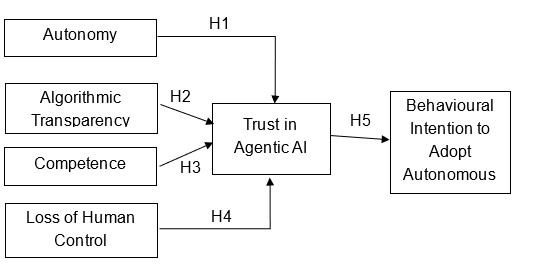
Conceptual Model
The model assumes that autonomous financial decision-making through Agentic AI creates user perceptions at the system level that impacts on trust, which subsequently generates behavioral intention. Particularly, autonomy, competence, and transparency should have a positive effect on trust whereas the loss of human control is expected to have a negative impact on trust. Trust is then a mediating variable that preconditions the intention of the user to adopt autonomous financial AI systems. Also, the generational gap between Gen Z and Millennials is likely to control the behavior of adoption.

Figure 1 : Conceptual Model Agentic AI Adoption of Autonomous Finance.
Research Gap
Although prior research has examined AI adoption in financial services, it mainly focuses on assistive and semi-autonomous systems, overlooking fully autonomous environments. The emergence of Agentic AI introduces a new paradigm involving full decision delegation, independent system agency, and minimal human involvement. The literature reveals key gaps, including lack of conceptual clarity, limited understanding of trust in fully autonomous settings, and insufficient empirical studies on user acceptance across generations. This study addresses these gaps by clearly defining Agentic AI and examining how system-level attributes influence trust and behavioral intention. It further contributes by analyzing generational differences and proposing a trust-centered framework for Agentic AI adoption.
One of the most notable findings of this study is the non-significant influence of Algorithmic Transparency (β = 0.081, p = .053) and Perceived Loss of Control (β = 0.062, p = .086) on Trust in Agentic AI. These results suggest that traditional determinants of trust identified in explainable and semi-autonomous AI settings may not operate similarly in highly autonomous Agentic AI environments. The absence of a significant transparency effect challenges prior Explainable AI (XAI) research, which generally identifies transparency as a key antecedent of trust .In the context of Agentic AI, users delegate both decision-making and execution to the system, reducing the practical value of understanding how decisions are made. Instead, trust appears to be formed primarily through perceptions of system competence and performance. Consistent with Automation Trust Theory users may rely more on outcome reliability than process explainability when interacting with highly autonomous systems. This finding suggests that performance-based trust may be more influential than explainability-based trust in agentic financial applications.
Similarly, the non-significant relationship between Perceived Loss of Control and Trust indicates that concerns regarding diminished user control may be less salient among digitally experienced users. Contrary to predictions from Reactance Theory (Brehm, 1966), respondents did not perceive reduced intervention capability as a substantial barrier to trusting autonomous AI systems. A possible explanation is that younger, technology-oriented users have become accustomed to delegating decisions to algorithmic systems such as recommendation engines, virtual assistants, and robo-advisors. Furthermore, the perceived benefits of efficiency, convenience, and optimized decision-making may outweigh concerns associated with reduced personal control. Collectively, these findings suggest that trust formation in Agentic AI differs from traditional technology adoption contexts. In highly autonomous environments, users appear to prioritize competence and performance outcomes over transparency and direct control. Consequently, existing technology adoption frameworks may require refinement to better explain user behavior in AI systems characterized by full decision delegation and high levels of autonomy.

Practical Implications
The findings offer several implications for fintech developers, financial institutions, and policymakers. First, building user trust should be a key design priority, particularly through demonstrating system reliability, accuracy, and consistent performance. Second, while transparency remains relevant, the results suggest that performance-based attributes such as competence and autonomy may play a more critical role in shaping perceived trust in autonomous systems.
However, these implications are derived from user perceptions rather than observed behavior, and should therefore be interpreted with caution. Organizations should complement user perception insights with behavioral analytics and real usage data when designing and deploying Agentic AI systems. Additionally, incorporating mechanisms such as audit trails, validation systems, and risk controls may help bridge the gap between perceived and actual trust. Finally, generational differences should inform user segmentation strategies, with younger users potentially more receptive to autonomous financial technologies.
 

This study has several limitations. First, the sample is restricted to Bangalore Urban, which may limit generalizability to other geographical and cultural contexts. Second, the study relies on self-reported perceptual data, which may be subject to response bias and may not fully reflect actual user behavior in real financial settings. The absence of behavioral or transactional data limits the ability to validate whether stated intentions translate into real adoption decisions. Third, the cross-sectional design does not capture changes in user perceptions over time, particularly as familiarity with autonomous ai systems evolves. Finally, generational differences were examined using mean comparison rather than multi-group structural equation modelling (mg-sem), limiting the ability to draw strong conclusions about moderating effects.
 
Respondent Characteristics
Gen Z and Millennial Bangalore Urban users provided 400 valid responses. The sample was almost equal, as 52 percent were Gen Z (n=208) and 48 percent Millennials (n=192), which allowed drawing significant comparisons between generations.

Generation Age Range     Frequency Percentage
Gen Z 18–26 years 208 52.0%
Millennials 27–42 years 192 48.0%
Total   400 100%
Table 3 : Respondent Profile

Descriptive Statistics
The descriptive statistics show moderate to high levels of Agentic AI capabilities perception. autonomy (Mean = 3.94) and competence (Mean =3.86) were also higher indicating that the respondents consider AI systems to be competent and able. The confidence in Agentic AI was moderate (Mean = 3.79), behavioral intention to use the such systems was lower in comparison (Mean = 3.07), so there is a reluctance to adopt them fully. These results imply that despite the awareness as to the capability of AI, apprehension exists regarding autonomous financial decision-making.

Construct Mean    Standard Deviation
 AI Autonomy 3.94 0.72
Algorithmic Transparency 3.74 0.69
 AI Competence 3.86 0.75
 Loss of Control 3.52 0.81
Trust in Agentic AI 3.79 0.73
Behavioral Intention 3.07 0.88
Table 4 : Descriptive Statistics

Assessment of measurement model.
The model was measured using Confirmatory Factor Analysis (CFA). Every construct that was employed demonstrated respectable validity and reliability. Internal consistency was guaranteed because the Cronbach alpha values were higher than the suggested value of 0.70. The study demonstrated convergent validity by Average Variance Extracted (AVE > 0.50) and Composite Reliability (CR > 0.70), and factor loading was determined to be above 0.70. The discriminant validity was verified using the Fornell-Larker criterion.

Construct Cronbach’s Alpha CR AVE Factor Loadings
Autonomy 0.84 0.88 0.59 0.71 – 0.83
Transparency 0.81 0.86 0.56 0.70 – 0.82
Competence 0.86 0.89 0.62 0.73 – 0.85
Control 0.78 0.83 0.52 0.69 – 0.80
Trust 0.88 0.91 0.65 0.75 – 0.87
Intention 0.85 0.89 0.61 0.72 – 0.84
Table 5 : Measurement Model – Reliability & Validity

A satisfactory match was shown by the model fit indices: χ²/df < 3, CFI and TLI ≥ 0.90, and RMSEA ≤ 0.08. These findings support the measurement model's suitability for additional structural investigation.

Fit Index Recommended Value Model Value
χ²/df ≤ 3.0 2.41
CFI ≥ 0.90 0.93
TLI ≥ 0.90 0.92
RMSEA ≤ 0.08 0.061
Table 6 : Model Fit Indices (CFA & SEM)

Correlation Analysis
The results of the correlation indicate that there are high positive correlations between the key constructs. Trust had the highest correlation with behavioral intention (r = 0.642, p < 0.01) meaning that it is in the middle of adoption. Trust was also strongly correlated with autonomy (r = 0.531) and competence (r = 0.564), indicating that system capability and independence are factors that lead to the development of trust. These relations give some initial reinforcement to the suggested model.

Construct Autonomy Transparency Competence Control Trust Intention
Autonomy 0.77          
Transparency 0.31 0.75        
Competence 0.43 0.38 0.79      
Control 0.21 0.28 0.25 0.72    
Trust 0.53 0.49 0.56 0.31 0.81  
Intention 0.49 0.38 0.45 0.24 0.64 0.78
Table 7 : Discriminant Validity (Fornell–Larcker Criterion)

Structural Model Evaluation.
The hypothesized relationships were tested in terms of structural model using SEM. This model showed a sufficient explanatory power (R2 = 0.52) which means that the predictors explain 52 percent of the variance of behavioral intention.
The results of the analysis highlights that:

Hypothesis Path Beta (β) t-value p-value Result
H1 Autonomy → Trust 0.214 5.83 <0.001 Supported
H2 Transparency → Trust 0.081 1.94 0.053 Not Supported
H3 Competence → Trust 0.176 4.92 <0.001 Supported
H4 Control → Trust 0.062 1.72 0.086 Not Supported
H5 Trust → Intention 0.498 11.26 <0.001 Supported
Table 8 : Structural Model Results (Hypothesis Testing)

The structural model has moderate explanatory power (R² = 0.52), explaining a significant fraction of the variance in behavioral intention. Trust has a significant impact on intention (β = 0.498), indicating its crucial role in adoption. autonomy (β = 0.214) and competence (β = 0.176) have modest effects, but transparency and control are weak and non-significant. This shows that performance-oriented parameters have a greater influence than interpretability-related elements in autonomous AI scenarios.

Role of Trust: Mediation Analysis.
Bootstrapping was done to conduct the mediation analysis. The results demonstrate that the relationship between behavioral intention and the autonomy and competency of AI systems is significantly mediated by trust. This suggests that the technologies' capabilities primarily influence adoption via influencing trust.

Relationship Indirect Effect p-value Mediation
Autonomy → Trust → Intention Significant <0.001 Partial
Competence → Trust → Intention Significant <0.001 Partial
Transparency → Trust → Intention Not Significant >0.05 Not Supported
Control → Trust → Intention Not Significant >0.05 Not Supported
Table 9 : Mediation Analysis

But as transparency and control were not critical predictors in the structural model, there were not any indirect effects on them through trust. Thus, mediation is supported only partially.

Multi-Group SEM: Generational Moderation Analysis
Multi-Group Structural Equation Modeling (MG-SEM) was conducted to examine whether generational differences (Gen Z: n = 208; Millennials: n = 192) moderate the proposed relationships. The sequential invariance testing procedure confirmed configural invariance (CFI = 0.92, TLI = 0.91, RMSEA = 0.064), indicating that the factor structure was consistent across both groups. Metric invariance was also established (Δχ²(16) = 19.4, p = 0.249; ΔCFI = 0.009), allowing meaningful comparison of structural paths. Partial scalar invariance was achieved after freeing two non-invariant intercepts, supporting latent mean comparisons.
Subsequently, structural path coefficients were compared across generations. The results revealed significant differences for the paths AI Competence → Trust and Trust → Behavioral Intention. Specifically, Gen Z respondents placed greater emphasis on AI competence when developing trust and demonstrated a stronger tendency to translate trust into adoption intentions than Millennials. No significant generational differences were observed for the effects of AI Autonomy, Algorithmic Transparency, or Perceived Loss of Control on Trust.
 

Path Gen Z (β) Millennials (β) CR Result
Autonomy → Trust 0.241 0.187 1.83 NS
Transparency → Trust 0.073 0.094 -0.74 NS
Competence → Trust 0.203 0.149 2.11 Significant*
Control → Trust 0.048 0.079 -1.22 NS
Trust → Intention 0.531 0.461 2.47 Significant*

*Note: Significant at p < 0.05; NS = Not Significant.

Table 10 : Structural Path Comparison Across Generations
This study examined the acceptance of Agentic AI in autonomous financial decision-making among Gen Z and Millennials in Bangalore Urban. The findings indicate that trust is a central determinant of adoption, mediating the relationship between system attributes and behavioral intention. Specifically, autonomy and competence significantly influence trust, whereas transparency and perceived control show limited direct effects. However, these findings are based on self-reported perceptions rather than observed behavior, and therefore reflect users’ intentions and attitudes toward Agentic AI rather than actual usage outcomes. Theoretically, the study contributes by extending technology adoption frameworks to fully autonomous, agent-driven environments and positioning trust as a core mechanism under conditions of decision delegation. Practically, the results suggest that fintech developers should prioritize system reliability, consistency, and performance to strengthen user trust. While the insights are indicative, further validation using behavioral data is necessary to confirm how these perceptions translate into real-world adoption.
 
Future research should extend this study by incorporating behavioral and transactional data to validate whether self-reported intentions translate into actual adoption of Agentic AI systems. Longitudinal studies are also needed to examine how trust and adoption evolve over time with increased exposure to autonomous technologies. Comparative studies across different geographical and cultural contexts would further enhance generalizability. Additionally, future research may adopt mixed-method approaches by combining survey data with real usage data or experimental designs to strengthen validity. Expanding the model to include factors such as perceived risk, privacy concerns, and ethical considerations would provide a more comprehensive understanding of adoption behavior. Finally, the use of multi-group sem (mg-sem) is recommended to rigorously assess moderating effects across demographic groups.
 
[1]   Balta-Ozkan, N., Boteler, B., & Amerighi, O. (2021). European smart home market development: Public views on technical and economic aspects across the United Kingdom, Germany, and Italy. Energy Research & Social Science, 74, 101956. https://doi.org/10.1016/j.erss.2021.101956
[2]   Dwivedi, Y. K., Hughes, L., Baabdullah, A. M., Ribeiro-Navarrete, S., Giannakis, M., Al-Debei, M. M., Dennehy, D., Metri, B., Buhalis, D., Cheung, C. M. K., Conboy, K., Doyle, R., Dubey, R., Dutot, V., Felix, R., Goyal, D. P., Gustafsson, A., Hinsch, C., Jebabli, I., … Wamba, S. F. (2021). Artificial intelligence (AI): Multidisciplinary perspectives on emerging challenges, opportunities, and agenda for research. International Journal of Information Management, 57, 101994. https://doi.org/10.1016/j.ijinfomgt.2019.08.002
[3]   Marikyan, D., Papagiannidis, S., & Alamanos, E. (2022). A systematic review of the smart home literature: A user perspective. Technological Forecasting and Social Change, 138, 139–154. https://doi.org/10.1016/j.techfore.2018.08.015
[4]   Pillai, R., Sivathanu, B., & Dwivedi, Y. K. (2022). Shopping intention at AI-powered automated retail stores. Journal of Retailing and Consumer Services, 68, 103002. https://doi.org/10.1016/j.jretconser.2022.103002
[5]   Shin, D. (2021). The effects of explainability and causability on perception, trust, and acceptance: Implications for explainable AI. International Journal of Human-Computer Studies, 146, 102551. https://doi.org/10.1016/j.ijhcs.2020.102551
[6]   Statista. (2024). Smart home and smart kitchen market worldwide – statistics and facts. Retrieved from https://www.statista.com
[7]   Talwar, S., Dhir, A., Kaur, P., Zafar, N., & Alrasheedy, M. (2021). Why do people share fake news? Associations between the dark side of social media use and fake news sharing behaviour. Journal of Retailing and Consumer Services, 60, 102374. https://doi.org/10.1016/j.jretconser.2020.102374
[8]   Tussyadiah, I. P., Miller, G., & Zhang, Y. (2020). Consumer acceptance of smart home technologies: An extension of the UTAUT model. International Journal of Hospitality Management, 91, 102689. https://doi.org/10.1016/j.ijhm.2020.102689
[9]   Venkatesh, V., Thong, J. Y. L., & Xu, X. (2022). Unified theory of acceptance and use of technology: A synthesis and the road ahead. Journal of the Association for Information Systems, 23(2), 328–376. https://doi.org/10.17705/1jais.00787
[10]  Wirtz, J., Patterson, P. G., Kunz, W. H., Gruber, T., Lu, V. N., Paluch, S., & Martins, A. (2020). Brave new world: Service robots in the frontline. Journal of Service Management, 31(5), 907–931. https://doi.org/10.1108/JOSM-04-2019-0114
[11]  Zhang, T., Tao, D., Qu, X., Zhang, X., Lin, R., & Zhang, W. (2021). The roles of initial trust and perceived risk in public acceptance of smart home services. Computers in Human Behavior, 118, 106677. https://doi.org/10.1016/j.chb.2021.106677
[12]  Huang, M. H., & Rust, R. T. (2021). A strategic framework for artificial intelligence in marketing. Journal of the Academy of Marketing Science, 49(1), 30–50. https://doi.org/10.1007/s11747-020-00749-9
SECTION–1: RESPONDENT INFORMATION
(This section gathers general background about the participant)

1 Name of Respondent (Optional) : __________________________
2 Place/Locality in Bangalore Urban : __________________________
3 Mobile Number (Optional) : __________________________
4 E-mail ID (Optional) : __________________________

SECTION–2: DEMOGRAPHIC PROFILE
Age in Years

  1. 18–22 yrs
  2. 23–26 yrs 
  3. 27–30 yrs 
  4. 31–35 yrs 
  5. 36–40 yrs 
  6. Above 40 yrs

Gender

  1. Male 
  2. Female 
  3. Prefer not to say

Education

  1. Higher Secondary 
  2. Diploma / Technical Training
  3. Bachelor’s Degree
  4. Master’s Degree
  5. Professional Qualification

Employment Status

  1.  Student 
  2. Salaried Employee 
  3. Self-employed / Business Freelancer 
  4. Other: __________

Have you ever used digital financial applications (e.g., UPI, mobile banking, investment apps)?

  1. Yes
  2. No

Have you ever used AI-based financial tools (e.g., robo-advisors, automated investment suggestions)?

  1. Yes
  2. No

SECTION–3: PERCEPTION OF AGENTIC AI
This section measures your perception of AI systems that can make financial decisions autonomously.
AI Decision Independence (3 items)

  1. I am comfortable with AI making financial decisions automatically for me.
  1. Strongly agree
  2. Agree
  3. Neutral
  4. Disagree
  5. Strongly disagree
  1. I am willing to let AI handle some of my financial tasks without my constant approval.
  1. Strongly agree 
  2. Agree 
  3. Neutral
  4. Disagree
  5. Strongly disagree
  1. I feel AI can independently manage routine financial activities effectively.
  1. Strongly agree 
  2. Agree 
  3. Neutral 
  4. Disagree
  5. Strongly disagree

Transparency of AI Decisions (3 items)

  1. I prefer AI systems that clearly explain the reasons for their financial decisions.
  1. Strongly agree 
  2. Agree 
  3. Neutral 
  4. Disagree
  5. Strongly disagree
  1. I feel more confident when AI explains how it decides on financial actions.
  1. Strongly agree 
  2. Agree 
  3. Neutral 
  4. Disagree
  5. Strongly disagree
  1. When AI provides clear explanations, I trust its decisions more.
  1. Strongly agree 
  2. Agree 
  3. Neutral 
  4. Disagree
  5. Strongly disagree

Perceived AI Competence (3 items)

  1. I believe AI can analyse financial data more accurately than most individuals.
  1. Strongly agree 
  2. Agree 
  3. Neutral 
  4. Disagree
  5. Strongly disagree
  1. AI can make better financial suggestions than humans in many cases.
  1. Strongly agree 
  2. Agree 
  3. Neutral 
  4. Disagree
  5. Strongly disagree
  1. I think AI can improve my financial outcomes if used regularly.
  1. Strongly agree 
  2. Agree 
  3. Neutral 
  4. Disagree
  5. Strongly disagree

Control & Comfort (3 items)

  1. I prefer to review AI decisions before they are executed fully.
  1. Strongly agree 
  2. Agree 
  3. Neutral 
  4. Disagree
  5. Strongly disagree
  1. I feel uneasy giving AI full control over my financial decisions.
  1. Strongly agree 
  2. Agree 
  3. Neutral 
  4. Disagree
  5. Strongly disagree
  1. Having some control over AI financial actions is important to me.
  1. Strongly agree 
  2. Agree 
  3. Neutral 
  4. Disagree
  5. Strongly disagree

SECTION–4: TRUST IN AI (3 items)

  1. I trust AI systems to make safe and reliable financial decisions.
  1. Strongly agree 
  2. Agree 
  3. Neutral 
  4. Disagree
  5. Strongly disagree
  1. I believe AI systems act in my best financial interest.
  1. Strongly agree 
  2. Agree 
  3. Neutral 
  4. Disagree
  5. Strongly disagree
  1. I feel confident relying on AI to manage some financial tasks.
  1. Strongly agree 
  2. Agree 
  3. Neutral 
  4. Disagree
  5. Strongly disagree

SECTION–5: INTENTION TO USE AI-BASED FINANCIAL SYSTEMS (3 items)

  1. I intend to use financial platforms where AI can make decisions automatically.
  1. Strongly agree 
  2. Agree 
  3. Neutral 
  4. Disagree
  5. Strongly disagree
  1. I would consider using a fully AI-managed financial service for investments or banking.
  1. Strongly agree 
  2. Agree 
  3. Neutral 
  4. Disagree
  5. Strongly disagree
  1. I am likely to use AI-driven financial tools regularly in the future.
  1. Strongly agree 
  2. Agree 
  3. Neutral 
  4. Disagree
  5. Strongly disagree
Figure 1 : Conceptual Model Agentic AI Adoption of Autonomous Finance.
Pain Text:
Deepthi H , Nikitha K , , Renushree S (2026), Navigating Autonomous Finance: Acceptance of Agentic AI Among Gen Z and Millennials in Bangalore Urban. Samvakti Journal of Research in Information Technology, 7(1) 34 - 57.